Wednesday, March 11, 2015

Remembrances (1981)

In the spring of 1981, our CUCC historian Ann Elleman recorded a series of interviews with long time CUCC members. This process lasted for several months, and Susie Sapp put in long ours to transcribe the interviews to text. The result was a 90-page single-spaced typed document that is packed full of first-person accounts of the early years of CUCC and the decades of life at the United Church of Raleigh that preceded formation of CUCC. In September of 2012, Lavon page scanned the report and indexed it so that it can be searched for individual participants. This has become a valuable resource to bring to life some of the names you hear so often when old timers talk about our past.

Remembrances (1981) (91 pages)

There is also a PDF version of this complete document available. The PDF version is not indexed, i.e. you can't jump to the interview of a specific person as the above list allows. But the complete PDF version is handy if you want to read or print the entire document. It's a 25 megabyte download.

PDF version (25 mb)

Tuesday, November 12, 2013

Origins of the phrase "Nurturing spiritual growth and working for social justice"

edited by Lavon Page using information provided by Edith Sylla, Marty Lamb, and Jane Smith

The phrase “Nurturing spiritual growth and working for social justice” has been widely used on church publications for many years. Some recall this slogan having been added to the church bulletin and website during the tenure of Rev. Carol Ripley-Moffitt as Interim Pastor (2000-2002). But others remember the phrase itself having originated while Rev. Cally Rogers-Witte was pastor, perhaps around 1990. This article provides an overview to the context out of which this phrase may have arisen. Most of this information was researched by Edith Sylla, church historian.

Marty Lamb (Nov. 2013) recalls that “Rev. Cally Rogers-Witte did apparently suggest to the Deacons the phrase 'working for social justice and nurturing spiritual growth.'  Geraldine Bryan (on the Deacons at the time) spoke up to say she'd approve its use IF the words were put in the proper order 'nurturing spiritual growth and working for social justice.' The Deacons did approve of the current statement, so that was the authoritative group in the church who gave approval for its use.”

We don’t have a date for this discussion, but given the statement of goals adopted at the congregational meeting June 17,1990, it may have been about this time.  Peggy Hoffmann refers to similar language in her review of church history during the 1980's in The “Energetic 80’s:  A decade in the life of a small Southern church” which includes the statement of goals (p. 21). And the phrase "Working for Social Justice" appears as a header on p. 20 of that document.

As a precursor to the fall retreat held in October 2012, Edith Sylla as church historian drafted an informal overview of church history related to this matter. Edith's findings (Oct. 2012) appear below, slightly edited by Lavon Page for purposes of online readability.


From the CUCC Archives re Long Range Planning in 1990

drafted by Edith Sylla, CUCC Historian, October 2012

In 1990, Peggy Hoffmann ended her update of CUCC history (“The Energetic Eighties: A decade in the life of a small southern church”) with the following section:


MOVING INTO THE 1990’S (excerpt from Peggy Hoffman's "Energetic 80s")

As CUCC enters the 1990’s we have set ourselves a new statement of goals, voted in a congregational meeting June 17,1990.


Goal Statement of Community United Church of Christ

As a worshipping community we recognize the God-given unity of our prayerful journey toward a deeper faith in God, our work for justice in the world and at home, and our quest to be a more loving community.

Therefore, as we move toward the twenty-first century, we commit ourselves to the challenge of affirming this unity in all that we do. Given this vision, we have set ourselves these priorities to address in the next three to five years.

  • Always to be conscious of the unity of our commitments to foster faith development in our congregation; engage in ministries of peace, justice, and mercy for the earth and the human family; and, create a more caring congregation.
  • To expand our ministry to and with children and youth in our congregation and in the community.
  • To make the best use of space and resources available to us and to assess and address our physical and financial needs in light of expected continued growth.


Here are some items from the files that explain the background of this goal statement:

Church Council September 18, 1989. Minutes
The planning process for 1990 is being discussed. The Deacons recommend a subcommittee from the Council to coordinate the effort.... Susie Sapp made a motion that a subcommittee, appointed by the Church Council, be formed to discuss long-range plans for the Church – to be accomplished by November and a recommendation to the congregation by January with implementation in winter/spring of 1990.

Church Council October 16, 1989. Minutes
Judy Smallwood reported that those who agreed to be on the long-range planning committee are John Bush, John Niblock, Pam Troutman, Bill Lamb, Judy Smallwood, Cally Rogers-Witte and Dave Barber. Cally feels that they should meet as soon as possible.

First Annual Congregational meeting January 7, 1990. Minutes
Dave Barber reported on Long Range Planning Committee by handing out a graph showing our worship attendance and budgets for the last 12 years, and explaining some of the interesting information depicted.

Church Council January 16, 1990. Minutes
Long Range Planning: Bill Lamb passed out a list of Priority issues as voted by the Congregation, prepared by John Niblock. It boils down to 4 themes. A narrative summary is being drafted to include these. Boards and committees in February will be asked to consider this re-written material on what they feel the church should stand for. This will also be asked of the Friendship Circles. The Committee will then develop the 5-year plan by May or June.

Pastor’s Report: Cally feels the challenge of the 90’s is to balance spiritual development and justice.... Cally will offer 4 sessions in February on UCC polity, with the 4th session reviewing Long Range Plan. ... Cally mentioned that our agenda needs to include a report from the Long Range Planning Committee.

Church Council February 19, 1990. Minutes
The Board of Deacons held a retreat on Sunday, February 18th to discuss Long-Range Planning.

Long Range Planning: Bill Lamb reported that the committee will be asking Boards and Committees for a 3-5 year plan. Meeting is planned with Friendship Circles Coordinators on Sunday.

Email from Cally
To: Long Range Planning Committee
From: Cally Rogers-Witte, April 24, 1990
Review of process up ‘till now:

  • Deacons’ evaluation of pastors last year led them to ask for more comprehensive, long range planning by the whole church, especially as they face spring ’90 decision about whether to continue to have two part-time pastors or not.
  • Fall of 1989 – Council appointed Long Range Planning Committee which began meeting in November.
  • LRP led the Jan. 7 Congregational meeting which included a time for being in touch with mission statements of our church and the denomination, then remembering highlights of the history of our local church and its involvement in mission, and surfacing dreams for the future of our church.
  • Out of that congregational discussion, LRP wrote a draft mission statement and priorities and then asked the various Boards and Committees to suggest what dreams/plans/hopes/future programs they might suggest for their own work and for the whole congregation.
  • All of the above was then shared with members and friends of the congregation at gatherings of the various Friendship Circles which gave feedback and added other ideas....
  • After all the meetings of Friendship Circles, the LRP committee reviewed all the suggestions and rewrote the mission statement and priorities for presentation to the Council for possible presentation to the Congregation, and they also listed the various ideas that should be routed to each Board of the Committee for possible further consideration, noting the ideas that seemed to be rather widely affirmed or mentioned a number of times.

LRP suggests that Council should be familiar with all this material and then should consider appointing three separate task forces to address each priority. LRP suggests that these task forces each be responsible to one (or more?) of the Boards, but have within the membership of each task force persons representing the different Boards and Committees affected by the priority....

There should be a way to be sure the work of all three task forces is coordinated....

In the same packet as the April 24  memo from Cally there is a version of the mission statement (probably by Cally) that includes elaborations of the three priorities. For the first, Cally explains:

(This includes our work for global justice, human rights, economic justice, peace, environmental stewardship, and to end hunger and homelessness. It also emphasizes our desire to always see the interrelatedness of all this work as well as the connections between spiritual growth and social ministry, and the effects on our own community’s life.... the commitment in the 1990’s is to a new articulation of these interrelationships and connections – so that, for example, we ask the prayer chains to pray for people in places of war or famine, and we remember to articulate scriptural and theological bases for our social actions, and we invite more and more people to participate in peace vigils and worship services as well as Bible Studies and Silent Saturdays ... keep the unity and connections always in the forefront!!)

In the same packet there are also elaborations of the second and third priorities and several pages of feedback from the Friendship circles.

On May 9, 1990 there was a long range planning retreat for the Council and LRP. There are hand-written minutes from this meeting.

Special Called Congregational meeting June 17, 1990
To consider the following business:

  1. Affirmation of the Goal Statement ... and the priorities it suggests.
  2. Report from Church Council and Long Range Planning Committee on appointment of task forces to work on each of the three priorities...

Minutes (selections)
The meeting was called to order by Bill Lamb, serving as Moderator...

John Niblock made a motion to approve the first priority of Goal Statement for the Church. Discussion:  Isabella Cannon spoke to the issue of unity in the goal statement to the effect that we should have an awareness of diversity and acceptance of different points of view. Dave added that the Goal Statement is not a statement of  “who we are” but where we want to be in the next few years. John Little added that he doesn’t think unity means conformity. Motion carried.
John Niblock made a motion to approve the second priority and mentioned different task forces and who will chair them.... each task force will have representatives from all committees.... Motion carried.

Church Council June 25, 1990. Minutes
Pastor’s Report. Dave reported that the congregation also approved the Long-Range Planning proposal. Only one task force (Unity) is without a chair.

Church Council September 24, 1990. Minutes
Long Range Planning: Bill Lamb reported on Space and Resources Task Force. Potential action items are purchasing nice stacking chairs for the rear of the sanctuary to receive overflow, installing sound system in sanctuary, enlarging church building by enclosing courtyard between Vaughan Wing and Library, and erecting a more sound-proof divider in large church school room (between kitchen and secretary’s office).

Church Council October 22, 1990.
Task Force on Unity: Quentin Lindsay handed in a written report. Four recommendations were presented: 1) Council could appoint an ad-hoc committee to encourage and support efforts by which all of us strive to achieve unity of spirituality and social concern. 2) Consider a congregational retreat. 3) Classes and discussion groups have “open houses” to which newcomers would be invited. 4) Consider a class “in-between” middle school youth and forum for youth groups.

It was moved and seconded that the report be accepted; motion carried. It was recommended that a copy of this report be included in the Newsletter with a cover letter standing that the “Council accepts this report and commends it to the attention of all individuals and committee members, requesting volunteers for an ad-hoc committee. Council welcomes feedback.” [This appeared in the November 1990 Newsletter. Copy of the report will be appended to this summary.]

Church Council, November 19, 1990. Minutes
Task Force on Children and Youth: John Niblock presented recommendations: 1) Internal: Resource guide for teachers; Year-end guide book; College-age youth group to be established. 2) External: Community Outreach theme adopted every month to be integrated into all youth activities. Cally suggested we ask Wider Outreach to take on the External recommendation. Geraldine made a motion that these recommendations and those of the Task Force on Space be put in the Newsletter for the congregation to consider. Motion carried. Jim Smith made a motion that a subcommittee of Council (3 moderators, treasurer, and secretary) should oversee implementation of Task Force recommendations. Motion carried.

These excerpts from the files are only a small fraction of what was going on at the time.

Sunday, March 17, 2013

Marge Eckels and Cy King - March 17, 2013

The Sunday Forum on March 17, 2013, featured a dialog between Marge Eckels and Cy King on their many years of participation in social action initiatives at CUCC. The moderator is Sue Cottle, and the event was filmed by Lavon Page at the request of the Social Justice Ministry.

This video is also available on YouTube.

Tuesday, January 8, 2013

A Conversation with Cy King

On January 8, 2013, Lavon Page sat down with Cy King in Cy’s apartment, and Cy talked for two hours about his memories of the period from the late 1940s until 1970 in Raleigh’s United Church, the forerunner of Community UCC. The dialog has been edited, and split into three segments totaling about 1 hour and 15 minutes.

A Conversation with Cy King - January 8, 2013 (Part 1 - 29 minutes)
A Conversation with Cy King - January 8, 2013 (Part 2 - 23 minutes)
A Conversation with Cy King - January 8, 2013 (Part 3 - 19 minutes)

Sunday, June 17, 2012

Cy and Carolyn King Award


On June 17, 2012, the 10:30 worship service featured a presentation of a special award to Cy and Carolyn King honoring their many years of effort on behalf of peace and justice issues. Carolyn was unable to attend for medical reasons, but Cy accepted the award and spoke (with his usual modesty) on their behalf. Part of the ceremony included that the award will be a repeating event at CUCC and will be given in honor of the Kings.

Saturday, September 10, 2011

Carson Roach Howell - Welcoming Sunday

In September 2011, Carson Roach-Howell produced this short video about Welcoming Sunday. Carson filmed and edited it, and Jackson Kiel interviews Pastor Steve Halsted. The video may also be viewed on YouTube.


Sunday, February 28, 2010

Conversations with Cy and Carolyn King

The primary focus of these conversations is on civil rights activities of the 1950s and 1960s. Other topics include the Institute of Religion at Community UCC, Cy's work at NCSU Libraries, and the Martin Luther King march held annually in Raleigh on the MLK Holiday.

These conversations took place in Cy and Carolyn's living room at Whitaker Glen. Robert Parrish is directing the conversation, and Lavon Page is filming and joining in occasionally.

Part 1 - In the Beginning

  • Carolyn reflects on growing up in Kentucky and working for the YWCA in Youngstown, OH
  • Influence of the YMCA and Blue Ridge Assembly on Cy's youth, and Cy's years at UNC
  • Cy takes a job at the NCSU Bookstore and Carolyn at the YWCA in Raleigh
  • Squabbles involving the Institute of Religion at the United Church in Raleigh


Part 2 - Integration Comes to the South

  • Integrating interstate transportation
  • Marching with students from Shaw University
  • Early relations with First Congregational
  • Carolyn helps start an integrated day camp, which in turn helps integrate state parks
  • The Institute of Religion plays a central role
  • Student Interracial Ministry


Part 3 - The 1960s

  • Testing the public accommodations civil rights legislation
  • Carolyn works with United Church Women, Rich Park, Method Day Care, and the Total Life Center
  • Cy remembers local politics of the 1960s, the recent MLK Planning Committee award, and the tragic loss of relations with local black churches in the 1990s


Part 4 - The Martin Luther King Day March and NCSU Library

  • Testing the public accommodations civil rights legislation
  • Carolyn works with United Church Women, Rich Park, Method Day Care, and the Total Life Center
  • Cy remembers local politics of the 1960s, the recent MLK Planning Committee award, and the tragic loss of relations with local black churches in the 1990s

Friday, August 8, 2008

Cy King Talks About World War II

On August 8, 2008, Cy agreed to an interview with the National Veterans History Archival Institute on his experiences in the infantry during the Second World War. This is Cy's story (26 minute video).

Friday, February 9, 2007

Bernie Brown's Short Stories

Bernie Brown has become a prolific writer of short stories and is presently working on a novel. Here Bernie talks about her writing and reads two of her recent short stories, both of which have appeared in North Carolina journals. Recorded February 9, 2007 in Bernie's home in north Raleigh.

Bernie chats about her writing(12:31)
Everybody Loves Sunflowers (read by Bernie Brown) (11:37)
Just an Ordinary Guy (read by Bernie Brown) (9:22)

Friday, December 15, 2006

Geraldine Bryan - A Children's Christmas

In 2005 "Dreams of Christmas" (available was written by Geraldine as a Christmas narrative for adults. In 2006 Geraldine presented a narrative for children (and all others who appreciate the clarity of childhood). This narrative was the central part of the Children's Christmas Eve service on December 24, 2006. Lavon Page collaborated.


Wednesday, November 15, 2006

Geraldine Bryan - An Interpretation of Noah

In the fall of 2006, Geraldine constructed an elaborate reflection and meditation on Noah. Lavon Page again collaborated with Geraldine in selecting images and music to fit the theme. And the video below, almost an hour long, resulted. Note that the video is broken into 10 parts.

The 10 parts to this video will play consecutively in the viewer below, which can be put into full screen mode. If you are viewing this page on a device (such as iPhone or iPad) which does not provide the ability below to view this series of videos, you can view them consecutively in full screen mode at the Vimeo website by clicking the following link.

https://vimeo.com/couchmode/album/2665640/sort:preset/82921925

Saturday, June 3, 2006

Lavon Page - Birmingham Summer 1965

A reflection by Lavon Page based on an incident that occurred in the summer of 1965. The setting is Birmingham, Alabama (more specifically the suburb of Fairfield). It was during George Wallace's first term as Governor of Alabama, and while Lavon was teaching at Miles College in Birmingham. (Miles College was where Joan Baez recorded her live version of "We Shall Overcome" which appeared on her second album in the early 1960s.) This reflection was recorded in the summer of 2006.


Receipt for bond money paid to get out of jail
Return of cash bond following acquital

Thursday, December 15, 2005

Geraldine Bryan - Dreams of Christmas

In 2005 "Dreams of Christmas" (available was written by Geraldine as a Christmas narrative for adults. In 2006 Geraldine presented a narrative for children (and all others who appreciate the clarity of childhood). This narrative was the central part of the Children's Christmas Eve service on December 24, 2006. Lavon Page collaborated with her on all three, helping to convert them from audio narratives to videos with the addition of music and imagery.


Saturday, July 2, 2005

Luis Alvarenga Ordination

Luis Alvarenga returned to CUCC on October 19, 2008 to be ordained into the ministry. Participating in the ceremony were Rev. Vertie Powers of Southern Conference of the UCC, Rev. Steve Halsted, and Rev. Robert Parish. The video below shows the conclusion of the ordination ceremony (19 minute video) . The story of Luis’ work and ministry is told in the newspaper article from 1999 shown below the video.


Friday, April 19, 2002

Did You Ever Know a Bird?

Before I formed you in the womb,
I knew you... -- Jeremiah 1:5

by Lavon Page, April 19, 2002

Have you ever known a bird? I don't mean do you know about "birds". Or even do you know about a specific kind of bird. I'm asking if you've ever known a unique, individual bird. Not a parakeet or some caged bird, but a wild bird free to come and go as it pleases.

This is the story of Pinky.

One spring day in 1999 I noticed a small bright red bird near my back deck. He caught my attention because he was not a cardinal, and cardinals are the only red birds in these parts that I am familiar with.

A quick check of a bird book showed conclusively that he was a male, summer tanager. According to the book summer tanagers are common in the southeast, so I'm certain that my unfamiliarity with the species was partially due to my inattentiveness and general ignorance of birds.

In any case, Pinky hung around for a few weeks at least and had several very predictable habits. One habit was sitting in a small, scrawny cedar tree near the back porch. He preferred a particular little branch in that cedar tree, and on most days he could be spotted there during both morning and evening hours. Since the branch is only about 15 feet from our table on the back porch, and only about 12 feet from the deck, this gave ample opportunity for watching and filming him. (I fiddle around a lot with digital movies, so "Pinky" movies get played fairly frequently in our house when I'm experimenting with digital video.)

Also, during the time he was here in 1999 his mate was frequently seen. We dubbed her "Mrs. Pinky". She was similar to him in size, but of an olive green color, a very pretty little bird. But she was more reclusive and was rarely seen up close.

We enjoyed Pinky immensely while he was here in the spring of 1999. It was the first time in my life that I felt I was coming to "know" a bird.

In the spring of 2000 when Pinky returned, I was thrilled. How did I recognize him? Don't all summer tanagers look more or less the same? Maybe so, but the fact that I had seen only one tanager near my house in 20 years, plus the fact that the bird that came in the spring of 2000 had a particular preference for the same pathetic little branch in the same scrawny little cedar tree that Pinky had liked the year before removed any doubt. It was Pinky!

And he displayed the same habits as the year before. He's a very bold little bird who doesn't mind if I'm 10 feet away as long as I'm not doing anything that looks threatening.

His return made me wonder, "Where has he been for the past 11 months?" I wrote Lynn Barber (my personal bird expert), and she said he probably winters in South America. Some Internet research revealed Ecuador as a possible destination for Pinky between his visits to Raleigh.

Pinky in the summer of 2001
After Pinky made another annual visit in the spring of 2001, I began to wonder, "How long do these birds live?"

I don't know the answer to that question, but I had the feeling that Pinky would be back this year. I got up yesterday morning and stuck my head out the back door and remarked to Jo, "I think Pinky might show up today." (I didn't really think that, but I was hoping, as I had been all week.)

Around dinner time I was at my computer trying out some things with a new piece of video editing software that I had just acquired. Jo was in the kitchen and muttered something about me playing "Pinky" movies. It didn't register immediately, but a few seconds later it dawned on me that she was hearing "Pinky" movies being played, and I wasn't playing any. I looked out the window and there he was, in the dogwood tree right over the back porch. It was almost as if he had located me through the window to announce his presence.

(That Jo picked up his voice is amazing to me. There is a constant drone of wrens at our house, and every one of them is 10 times as loud as Pinky. How she picked out his small voice among all the shrill chirping of the wrens I can't imagine.)

Pinky in 2002
I went outside with my camera, but he backed off to a tree about 40 feet away, where he sat and alternately eyed me and engaged in seemingly random cheeping. I couldn't get good pictures from that distance, but I started thinking along the following lines:

"I don't need to take pictures now, because I know as surely as I know anything that in about 10 minutes he's going to be sitting on that same 1/4 inch diameter branch in that little cedar tree."

And sure enough, I came back out 10 minutes later and there he was on his favorite branch (see picture).

Now this is sort of scary if you think about. Here's a bird (not a person, a bird!) that I haven't seen for a year. I've observed him for about 60 seconds. And I know exactly where he's going to be in 10 minutes.

Most folks don't know that much about their own kids.

Now I'm not sure what the moral of this story is, but I do know that I shed a few tears at 4 AM this morning thinking about it. For one thing the story tells me that there is a level of "knowing" that we're oblivious to 99.9% of the time, but which occasionally (and miraculously) by serendipity breaks through our fog. The sermon that Dave Barber preached on angels years ago comes to mind. Angels come in many forms, and their message is often garbled and confusing.

Pinky is some sort of angel. I think he's telling me that even though I'm not paying much attention there is an order about me that is greater than my comprehension. And "knowing" this little bird has in a small way helped my understanding of what it means to be known.

"Before I formed you in the womb I knew you... -- Jermiah 1:5"

Epilog: In March 2003 I moved away from the house in the woods. I suspect that Pinky returned a month later. I told the new owner about Pinky, but I don't think she ever noticed him. 

Friday, July 29, 1988

The Energetic 80s - by Peggy Hoffmann

Peggy Hoffmann wrote a description of activities at CUCC during the decade of the 1980s and named it “The Energetic 80s”.

The Energetic 80s (PDF) (24 pages)

Saturday, April 25, 1981

Liberal Tradition (1981)

Newspaper article on CUCC in Raleigh Times from April 25, 1981 entitled "Church Celebrates its Liberal Tradition."


 Click any photo to view large versions of all photos 


Saturday, February 3, 1979

A Peculiar People - By Peggy Hoffmann

In the 1970s Peggy Hoffmann, with help from others, wrote this play to paint an overview of the history and essence of Community UCC.

A Peculiar People (PDF) (15 pages)

Tuesday, October 4, 1977

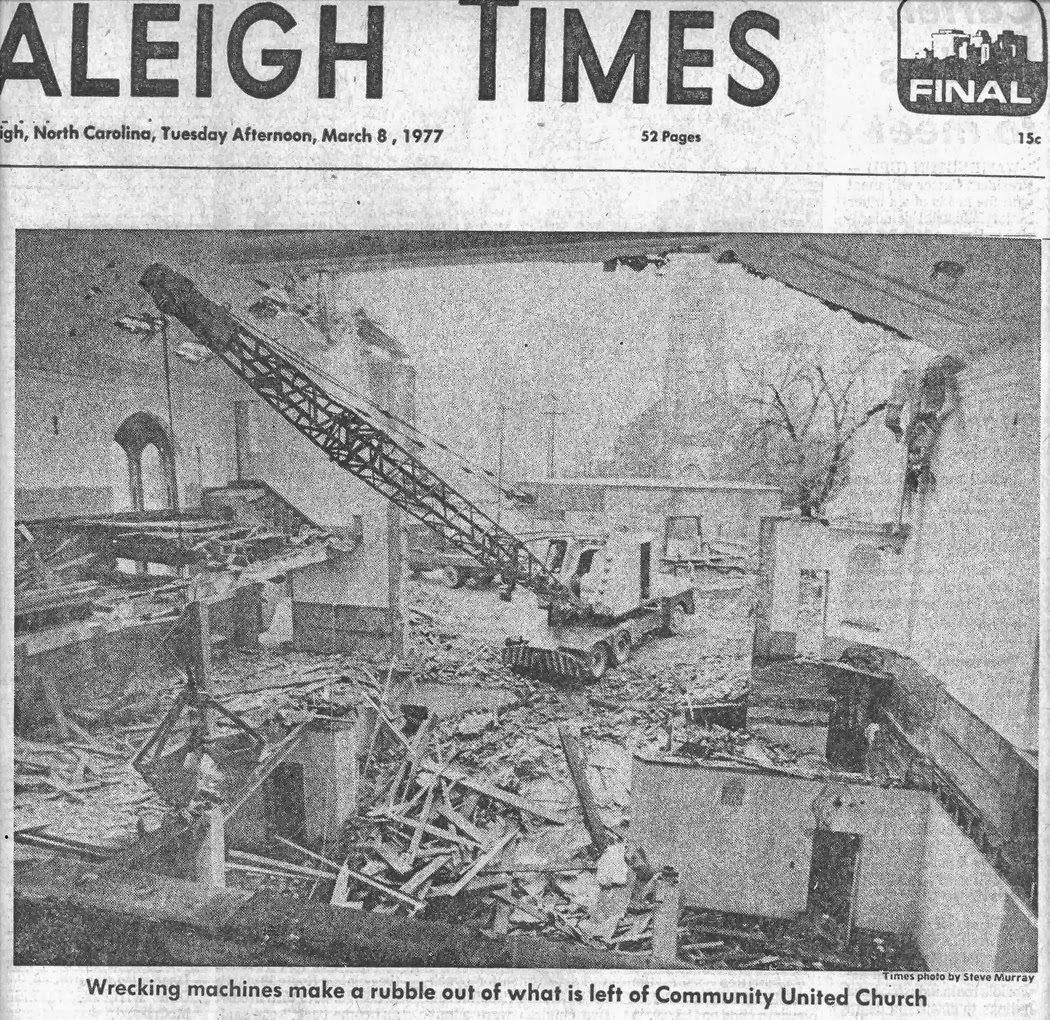
Demolition of United Church - 1977

Newspaper coverage from 1977 on demolition of the United Church building in downtown Raleigh. This church was the predecessor to the present CUCC.

  Click any photo to view large versions of all photos  


Sunday, May 27, 1973

Historical Sketch of the United Church of Raleigh

Stuart Noblin was a member of the United Church of Raleigh during the 1960s, as well as a historian at NC State. He wrote two histories of the United Church. The brief one below was written in 1967 as part of a self-study project within the church. The longer one entitled “The United Church of Raleigh: A Case Study” was written two years later and is also available in this archive (link on left).

Historical Sketch of United Church of Raleigh (PDF)